For a rapidly scaling SaaS startup, network security rarely keeps pace with growth. Engineering teams add firewall rules to ship fast, cloud environments multiply across regions, and a lean security team tries to maintain visibility across all of it without slowing the business down. The result is a sprawling, inconsistent ruleset that creates exposure without anyone fully understanding the scope of the problem.
Propelex deployed a Managed Firewall Service covering the client’s complete multi-cloud and hybrid environment — conducting a full baseline audit, remediating years of accumulated policy debt, and establishing continuous monitoring and governance that scales with the business.
About the Client
The client is a rapidly scaling SaaS technology startup operating a fully cloud-driven environment with a distributed remote workforce. With aggressive customer onboarding, expanding engineering teams, and active multi-region deployments, the company’s network and edge security complexity had grown faster than its internal team could manage. The client name is kept confidential under NDA.
The Security Challenge
As the organization grew, network security policy management became increasingly fragmented. Multiple teams were managing firewall rules independently — each solving their immediate problem without visibility into the downstream effects on the broader security posture.
- Fragmented firewall rules created by multiple teams without centralized oversight — no single owner, no consistent standard, and no audit trail of who added what and why
- Overly permissive inbound and outbound policies left broad exposure across cloud environments, including multiple wide-open CIDR ranges (0.0.0.0/0) that should never reach production
- No centralized visibility or change governance — rule modifications happened without formal review, creating configuration drift and shadow rules that masked high-priority policies
- Cloud security groups across AWS and Azure were misaligned with least-privilege principles, creating unnecessary attack surface across the infrastructure
- VPN tunnels, VPC peering, and microservices traffic had grown complex enough that the lean internal security team could not effectively monitor it manually
An initial Propelex audit found that 37% of existing rules were either unnecessary or duplicated — a direct reflection of years of reactive rule additions without corresponding cleanup.
Propelex Managed Firewall Service
Propelex structured the engagement across four workstreams — assessment, architecture hardening, continuous monitoring, and change governance — each building on the previous to create a sustainable managed security operation.
Initial Assessment and Baseline Review
Full audit of cloud-native firewalls (AWS Security Groups, NACLs, Azure NSGs), virtual firewalls supporting VPN and customer integrations, microservices ingress/egress rules, and DevOps-maintained temporary rules
Policy Cleanup and Architecture Hardening
Structured remediation using CIS Benchmarks and NIST SP 800-41 — consolidating redundant rules, applying least-privilege access, validating east-west and north-south traffic segmentation, and aligning rulesets with CI/CD deployment cadence
Continuous Monitoring and Threat Prevention
Real-time event correlation, alerts for anomalous port scans and unauthorized access attempts, cloud API activity monitoring, and AI-assisted log interpretation — reducing mean time-to-detect for firewall-related threats from hours to minutes
Change Management and Governance
Standardized request-review-implement-validate workflow, SLA-based support for urgent rule additions, monthly configuration drift reports, and quarterly architecture reviews aligned with business growth
Integration with DevOps
One of the most impactful outcomes of the engagement was the integration of automated rule validation directly into the client’s CI/CD pipeline:
Automated Rule Validation in CI/CD
Propelex designed and implemented a standardized firewall ruleset aligned with the client’s CI/CD deployment cadence — with automated validation checks running as part of every deployment pipeline. New services cannot be deployed with misconfigured security groups or overly permissive access rules without the pipeline flagging the issue before it reaches production.
Standardized Tagging for DevOps Workflows
A consistent tagging framework was implemented across all firewall resources — enabling engineering teams to understand the purpose and owner of every rule without requiring security team involvement. This significantly reduced the volume of rule additions that required manual security review while maintaining governance over the most sensitive policy areas.
The Results
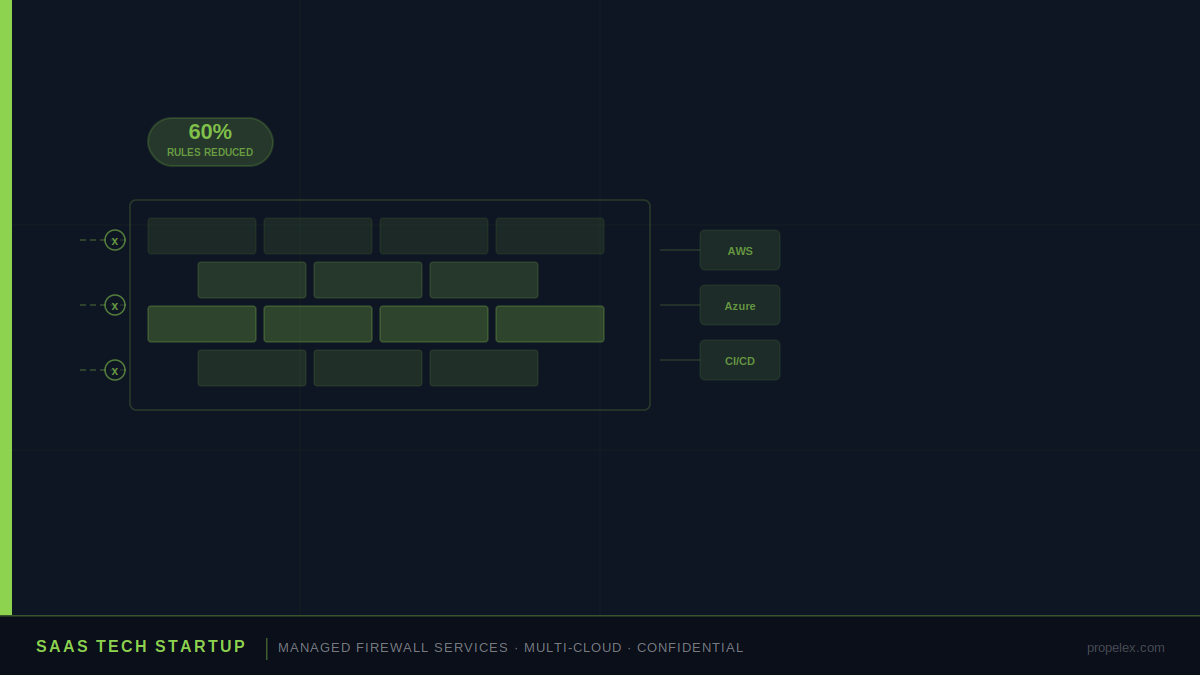
60% Reduction in Permissive Rules
The baseline audit and structured remediation eliminated 60% of overly permissive rules across cloud and edge environments — reducing the attack surface significantly while preserving all legitimate traffic flows.
Zero Unauthorized Inbound Ports
Every inbound port exposed to the internet was validated against a documented business requirement. Wide-open CIDR ranges and unauthorized service exposures were eliminated entirely, leaving a clean and fully justified inbound policy.
Accelerated DevOps Releases
Automated rule validation integrated into the CI/CD pipeline removed firewall misconfiguration as a source of deployment delays and post-deployment incidents — engineers ship faster with confidence that security checks run automatically.
Improved Platform Uptime
Conflicting and shadow rules that had been causing intermittent traffic disruptions were identified and eliminated. The cleaner, conflict-free policy set directly improved platform reliability and reduced time spent investigating network-related incidents.
Ongoing Partnership
Propelex continues to manage the company’s firewall operations — providing ongoing tuning, quarterly architecture reviews, and proactive hardening as new services and regions are deployed. This long-term partnership ensures that network security scales with the business rather than trailing it.
Key Takeaway
Firewall rule sprawl is one of the most common and least visible security problems in fast-growing SaaS companies. Rules accumulate faster than they are reviewed, permissions expand under delivery pressure, and the security team is too stretched to maintain continuous oversight. The result is not dramatic — no single catastrophic misconfiguration — just a steady erosion of security posture that creates meaningful exposure over time.
Managed Firewall Services address this directly. Propelex provides the continuous governance, monitoring, and expertise that a lean internal team cannot maintain alone — ensuring that the startup’s network security posture keeps pace with its growth, rather than becoming an increasing liability as the business scales.



 AI Security & Governance